






Window Film vs. Blinds vs. Curtains: Which Is Best for Heat Reduction?
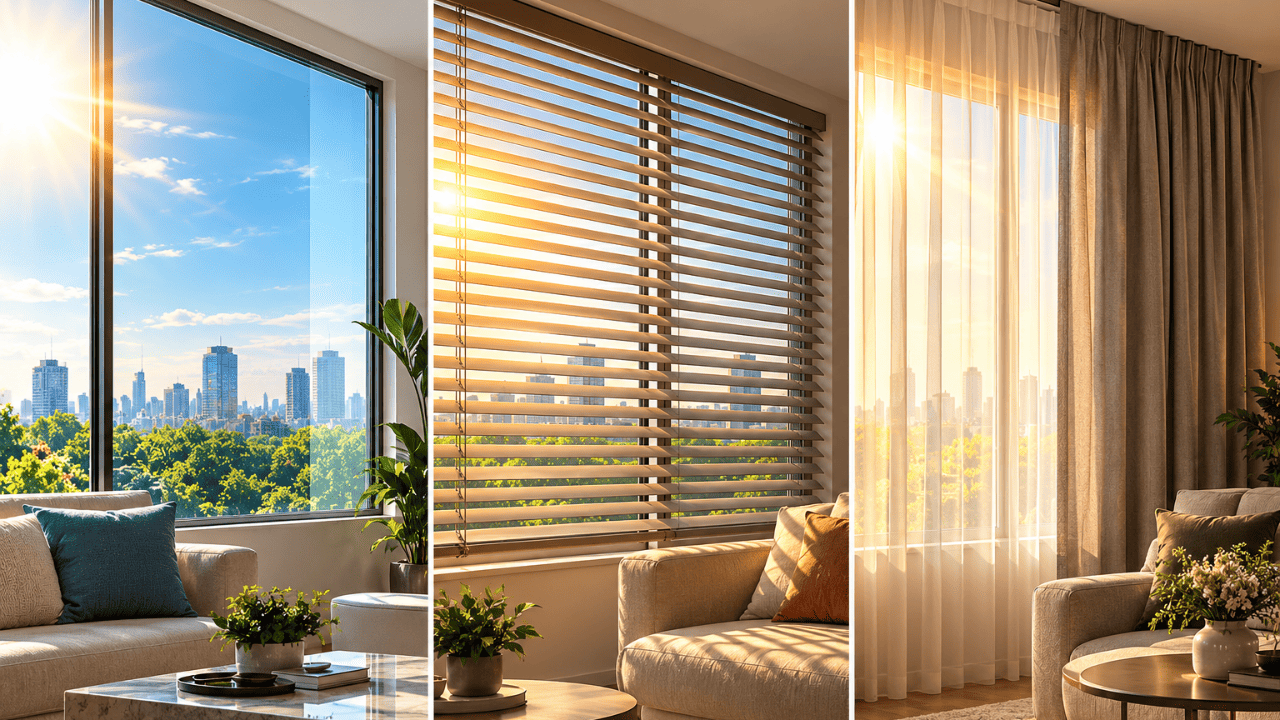
Window film, blinds, and curtains help manage indoor heat in different ways. Solar control window film modifies the performance of the glass to reduce solar heat gain, while blinds and curtains control sunlight and can provide additional insulation. The results depend on the film's specifications, window type, curtain or blind design, and local climate.
For homeowners who want to reduce heat while maintaining natural light and outdoor views, solar control window film is worth considering. Blinds and curtains may be better suited to adjustable privacy, light control, and decorative preferences.
How Do Window Film, Blinds and Curtains Reduce Heat?
To determine which option is best for your home, it helps to understand the mechanics of how each treatment interacts with sunlight.
- Window Film: Applied directly to the interior surface of the glass, solar control films can reflect and absorb portions of incoming solar energy. Actual performance depends heavily on the specific film’s specifications (such as Total Solar Energy Rejected, or TSER) and the existing glazing system.
- Blinds: Interior blinds work by blocking or reflecting direct light. While basic blinds may let heat pass around the edges, reflective blinds and well-designed shades (like cellular or honeycomb shades) can help reduce heat gain when appropriately selected and used. However, they still manage heat after it has passed through the glass.
- Curtains and Drapes: The performance of curtains varies significantly based on the material. Sheer curtains offer minimal heat control, while insulated or blackout curtains can trap air and reduce heat transfer. However, dark-colored fabrics can absorb solar radiation, heat up, and radiate that warmth back into the room.
Window Film vs Blinds vs Curtains: Heat Reduction Compared
Compare window film, blinds, and curtains based on heat reduction, natural light, UV protection, maintenance, and overall performance to determine which option best suits your home.
Feature | Window Film | Blinds | Curtains / Drapes |
| Heat Reduction | Manages solar heat gain directly at the glass. | Provides variable insulation and light blocking depending on material and fit. | Provides variable insulation; performance depends on fabric density and lining. |
| View Preservation | Preserves views depending on the film's VLT and reflectivity. | Offers variable views depending on the blind's design and position. | Offers variable views depending on the curtain's opacity and position. |
| Natural Light Control | Provides a fixed level of light transmission. | Offers adjustable control via tilting or raising. | Offers adjustable control via drawing or tying back. |
| UV Protection | High-quality films block up to 99% of UV rays. | Varies by product; minimal unless specifically treated. | Varies significantly based on fabric density and lining. |
| Maintenance | Low (easy to clean with standard glass cleaner). | Moderate to high (collects dust, requires wiping). | Moderate to high (requires regular washing or dry cleaning). |
Pros and Cons of Window Film, Blinds and Curtains
Window Film
- Pros: Works automatically all day, cuts glare, blocks UV fading, and preserves your outward view.
- Cons: Offers fixed light-filtering levels (cannot be opened or closed) and requires professional installation for optimal results and warranty coverage.
- Best For: Homeowners who want to reduce heat and glare without sacrificing natural light or interior space.
Blinds
- Pros: Allows precise angle adjustment for light and privacy. Generally offers a lower upfront cost.
- Cons: Can let heat pass around edges and gaps. Slats collect dust and require regular cleaning.
- Best For: Rooms where adjustable light control and privacy are top priorities, such as home offices or bathrooms.
Curtains and Drapes
- Pros: Excellent for blocking light completely and adding room insulation or sound dampening. Highly customizable for interior design.
- Cons: Can absorb and radiate heat if made of dark fabric. Blocks natural light entirely when closed and requires frequent washing.
- Best For: Bedrooms where total light blocking is desired for sleep, or for adding decorative warmth and insulation.
How to Choose Window Film for Heat Reduction?
Not all window films are created equal. When selecting a film specifically for heat reduction, consider the following:
- Solar Control and Spectrally Selective Films: These are designed to reject a high percentage of solar energy. Spectrally selective films are particularly advanced, as they can block infrared heat and UV rays while allowing a high percentage of visible light to pass through.
- Performance Metrics: Look at the Total Solar Energy Rejected (TSER) and Solar Heat Gain Coefficient (SHGC) ratings, alongside Visible Light Transmission (VLT). A high TSER and low SHGC indicate better heat rejection.
- Glass Compatibility: It is critical to verify that the chosen film is approved for your specific glazing (e.g., single-pane, dual-pane, or Low-E glass). Applying the wrong film can cause uneven heating and thermal stress, potentially cracking the pane.
Manufacturers like Global Hi-Tech Films offer a range of spectrally selective and solar control architectural films designed to balance high heat rejection with glass compatibility and optical clarity.
Can You Combine Window Film with Blinds or Curtains?
Yes. Combining treatments is often the most effective strategy for extreme climates.
Applying solar window film reduces solar heat gain according to the film's rated performance, acting as the first line of defense at the glass. Pairing this with blinds or curtains can provide a secondary layer of insulation and adjustable privacy. However, the effectiveness of this secondary layer depends entirely on the covering's construction, fit, and material.
How to Choose Between Window Film, Blinds and Curtains?
When deciding between window film, blinds, or curtains, consider the following factors:
- Window Orientation: South- and west-facing windows receive the most intense heat. These areas benefit most from the proactive heat rejection of window film.
- Desire for Natural Light: If you want to keep a room bright and maintain a connection to the outdoors, window film is the superior choice. Blinds and curtains will inherently sacrifice daylight when deployed.
- Budget and Maintenance: Consider both the initial investment and long-term upkeep. While film has a higher initial cost, its lack of moving parts and dust accumulation often makes it a highly durable, low-maintenance option.
Final Verdict: Which Window Treatment Is Best for Reducing Heat?
There is no single "best" window treatment, as the ideal choice depends on your specific needs for heat reduction, light control, and aesthetics.
- Choose blinds or curtains if your primary goals are adjustable privacy, total light blocking, or adding decorative insulation.
- Choose window film if your priority is to proactively manage solar heat gain at the source while preserving natural daylight, outward views, and a clean, modern aesthetic.
For many homeowners, the ultimate solution is a combination of both. By applying high-performance architectural window film from a trusted manufacturer like Global Hi-Tech Films, you can significantly reduce your home's heat gain, creating a more comfortable, energy-efficient environment that pairs perfectly with your favorite interior decor. Always consult with a certified professional installer to verify glass compatibility and select the optimal film for your home.
FAQs About Window Film, Blinds and Curtains
- Is window film better than blinds for reducing heat?
Window film is generally more effective at preventing heat from entering the room because it manages solar energy directly at the glass. However, well-designed blinds, like cellular shades, can still provide meaningful insulation and energy savings when used correctly. - Is window film more effective than blackout curtains?
Blackout curtains are excellent at insulating a room and blocking light, but they do not stop solar energy from hitting the glass. Window film actively rejects solar energy at the source, making it more effective at preventing heat from entering the space in the first place. - Do window films reduce heat without blocking natural light?
Yes. High-VLT (Visible Light Transmission) and spectrally selective window films are specifically designed to reject infrared heat and UV rays while allowing a high percentage of natural daylight to pass through, keeping rooms bright. - Can you use window film with existing blinds or curtains?
Yes. Window film and interior window treatments are highly complementary. The film handles solar heat rejection at the glass, while blinds or curtains provide adjustable privacy, light control, and additional insulation. - What type of window film is best for heat reduction?
Spectrally selective and high-performance solar control films are best for heat reduction. Always compare the product’s Total Solar Energy Rejected (TSER) and Solar Heat Gain Coefficient (SHGC) ratings to ensure it meets your specific needs. - Do thermal curtains help keep a room cool in summer?
Thermal curtains can help by creating an insulating air pocket that reduces heat transfer. However, if the outer fabric is dark, it may absorb sunlight and radiate heat inward, so light-colored thermal curtains are preferable for summer cooling. - Can window film help reduce air conditioning costs?
Yes, window film can potentially help reduce air conditioning costs by lowering the amount of solar heat entering the home. However, actual savings depend on the property’s orientation, existing glass, climate, and the specific film installed. - Does window film work on double-pane windows?
Yes, but you must choose a film specifically approved by the manufacturer for dual-pane or Low-E glass. Using an incompatible, high-absorption film can cause thermal stress and increase the risk of the glass cracking.
.png)


 English
 German
 Spanish
 French
 Arabic
 Chinese
 Turkish
 Russian