




Automotive Window Tint Thickness Guide: Types, Measurements & Benefits
.png)
When you shop for tint, you'll see numbers like "1.5 mil" or "2-ply" on spec sheets. It's natural to assume a thicker film means better protection. But automotive window tint thickness tells you less about performance than most people think. A thin ceramic film can easily outperform a thicker dyed one when it comes to heat rejection.
So how thick is car window tint, and does it really matter? Most standard automotive films are around 1.5 to 2 mil thick, while security films for cars start around 4 mil. In this guide, we'll explain how tint thickness is measured, compare the main film types, and help you choose what's right for your vehicle.
How Is Window Tint Thickness Measured?
Mil Thickness Measurement
In the US, window film is measured in mils. One mil equals one-thousandth of an inch (0.001 in). It's not the same as a millimeter, which is about 39 times thicker. So when you see car tint thickness in mils, a "2 mil" film is just 0.002 inches thick, thinner than a typical sheet of paper.
Micron Measurement
Some manufacturers list thickness in microns (µm), a metric unit equal to one-thousandth of a millimeter. The conversion is simple:
- 1 mil = 25.4 microns
- 1.5 mil ≈ 38 microns
- 2 mil ≈ 51 microns
- 4 mil ≈ 102 microns
Window Film Layers
Most automotive tint isn't a single sheet. It's built from several thin layers bonded together:
- Adhesive layer: Bonds the film to the inside of the glass.
- Base polyester layer(s): Holds the dye, carbon, ceramic or metal that controls heat and light. Many films are "2-ply," meaning two polyester layers laminated together.
- Scratch-resistant hard coat: Protects the inside surface from everyday wear.
- Release liner: Peeled away during installation, so it isn't counted in the film's final thickness.
Window Tint Thickness Comparison
This window film thickness guide shows typical ranges. Exact figures vary by brand and product line, so always check the manufacturer's spec sheet.
Film Type | Typical Thickness | Approx. Microns | Common Use |
| Standard automotive tint (dyed, carbon, ceramic) | 1.5–2 mil | 38–51 µm | Heat, glare, UV and privacy control on car windows |
| Automotive security film | About 4 mil | About 102 µm | Resisting smash-and-grab break-ins |
| Architectural safety film | 4–8 mil | 102–203 µm | Holding broken glass together in homes and offices |
| High-security architectural film | 8–14 mil or more | 203–356 µm+ | Banks, government buildings, storm protection |
The big takeaway: most car tints, whether dyed, carbon or ceramic, fall in the same 1.5–2 mil range. What separates them is the technology inside the film, not its thickness.
Types of Window Tint Film
Dyed Window Film
Dyed film uses layers of dye to darken the glass and absorb some solar heat. It's the most affordable option and gives a flat, dark look. The downside is durability: the dye can fade or turn purple over time, and heat rejection is modest compared with newer films.
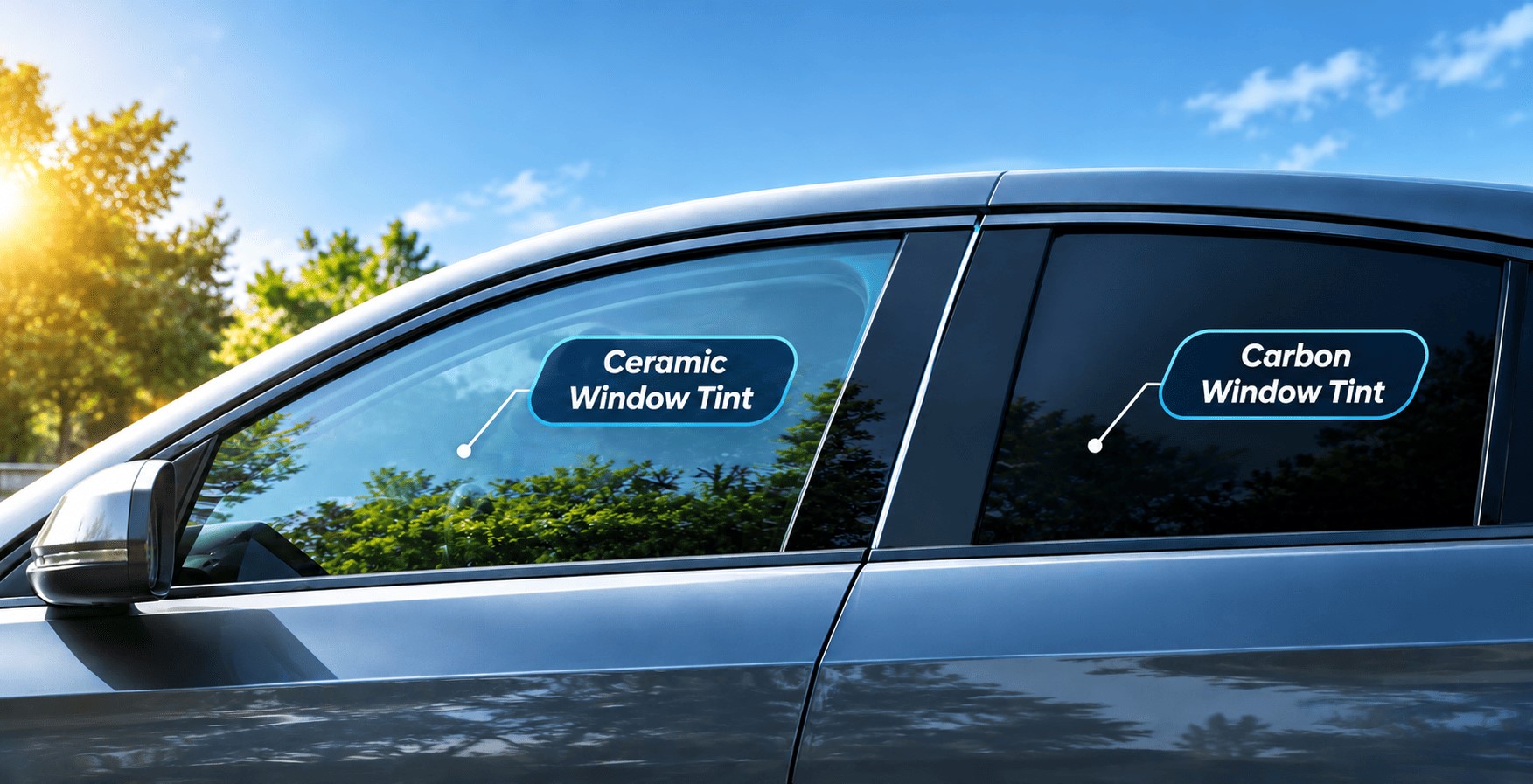
Carbon Window Tint
Carbon window tint uses carbon particles to absorb infrared heat. It has a matte finish, resists fading well and won't interfere with phone or GPS signals. Many carbon films are built in a 1.5 mil, 2-ply construction, the same thickness as many dyed and ceramic films.
Ceramic Window Tint
Ceramic window tint uses non-conductive nano-ceramic particles that target infrared heat. It typically offers the strongest heat rejection performance of the three, even in lighter shades, along with excellent clarity. Again, many ceramic films are around 1.5 mil thick, proving that thickness isn't what drives performance.
Metalized and Security Films
Metalized films use tiny metal particles to reflect heat but can affect electronic signals. Security films are much thicker, usually around 4 mil for cars, and are designed to hold shattered glass together and slow down break-ins.
Does Thicker Tint Mean Better Performance?
Not when it comes to heat. Here's how thickness really affects automotive window film specifications:
- Heat rejection performance: Determined mainly by the film's technology (dye, carbon, ceramic or metal), not its thickness. A 1.5 mil ceramic film can reject more heat than a thicker dyed one.
- UV protection and durability of window film: Most quality films block up to 99% of UV rays regardless of thickness. Durability depends more on film quality, color-stable construction and installation.
- Impact and break-in resistance: This is where thickness matters. Thicker security films are harder to puncture and help hold glass together after impact.
- Ease of installation: Thinner films are more flexible, so they conform more easily to the curved rear windows of modern cars. Very thick films are harder to shrink and fit on curves.
Best Thickness for Car Window Tint
For most drivers, the best car window tint thickness is the standard 1.5–2 mil range. It's thin enough to install cleanly on curved glass and thick enough to hold up for years. Rather than chasing a thicker film, focus on what's inside it:
- Want maximum heat rejection? Choose ceramic film.
- Want a balance of price and performance? Carbon film is a strong middle ground.
- On a tight budget? Dyed film works, but expect it to fade sooner.
- Worried about break-ins? Consider a 4 mil automotive security film.
Tips for Choosing Automotive Window Film
- Read the full spec sheet. Look at total solar energy rejected (TSER), infrared rejection, UV rejection and visible light transmission (VLT), not just thickness.
- Check your state's tint laws. Every US state sets its own VLT limits for front, rear and back windows.
- Ask about color stability. Color-stable films resist turning purple over time.
- Choose a professional installer. Proper heat-shrinking and edge work matter as much as the film itself.
- Look for a solid warranty. Quality films usually cover bubbling, peeling and fading.
Global Hi-Tech Films offers automotive window films in a range of technologies and shades, so you can choose the heat rejection, privacy and look that suits your car.
Conclusion
Automotive window tint thickness is useful to understand, but it's not the measure of a great film. Most car tints, from dyed to ceramic, sit in the 1.5–2 mil range, and their real differences come from the technology inside. Thickness becomes important mainly for security films, which are built thicker to resist impact. Focus on heat rejection, UV protection, color stability and quality installation, and you'll get tint that keeps your car cooler and looks great for years.
Frequently Asked Questions
- How thick is car window tint?
Most automotive window tint is about 1.5 to 2 mil thick, or roughly 38 to 51 microns. Automotive security films are thicker, usually around 4 mil. - What does "mil" mean in window tint?
A mil is one-thousandth of an inch (0.001 in). It's not a millimeter. One mil equals 25.4 microns. - Is thicker window tint better?
Not for heat rejection. Performance comes from the film's technology, such as carbon or ceramic. Thicker films mainly add impact and break-in resistance. - What does "2-ply" mean?
It means the film is made from two layers of polyester laminated together, which can improve durability and color stability. - Does thicker tint block more UV rays?
Not necessarily. Most quality films block up to 99% of UV rays, regardless of thickness. - Can thick security film be used on all car windows?
It's commonly used on side and rear windows. Because it's stiffer, it can be harder to fit on strongly curved glass, so ask your installer what works for your vehicle. - Does tint thickness affect tint laws?
State tint laws are based on visible light transmission (VLT), not thickness. A thin film can still be too dark to be legal, so always check the VLT rating.
.png)
 (1).png)

 English
 German
 Spanish
 French
 Arabic
 Chinese
 Turkish
 Russian